Enhanced Object Detection and Classification via Multi-Method Fusion
Duration
2023
Supported by
This work was supported by a grant from the Basic Science Research Program through the National Research Foundation (NRF) (2021R1F1A1063634) funded by the Ministry of Science and ICT(MSIT), Republic of Korea. This research is supported and funded by Princess Nourah bint Abdulrahman University Researchers Supporting Project number (PNURSP2023R410), Princess Nourah bint Abdulrahman University, Riyadh, Saudi Arabia. The authors are thankful to the Deanship of Scientific Research at Najran University for funding this work under the Research Group Funding program grant code (NU/RG/SERC/12/6).
Project Description
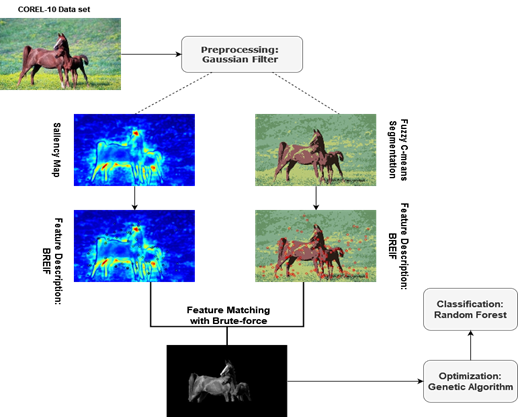
Advances in machine vision systems have revolutionized applications such as autonomous driving, robotic navigation, and augmented reality. Despite substantial progress, challenges persist, including dynamic backgrounds, occlusion, and limited labeled data. To address these challenges, we introduce a comprehensive methodology to enhance image classification and object detection accuracy. The proposed approach involves the integration of multiple methods in a complementary way. The process commences with the application of Gaussian filters to mitigate the impact of noise interference. These images are then processed for segmentation using Fuzzy C-Means segmentation in parallel with saliency mapping techniques to find the most prominent regions. The Binary Robust Independent Elementary Features (BRIEF) characteristics are then extracted from data derived from saliency maps and segmented images. For precise object separation, Oriented FAST and Rotated BRIEF (ORB) algorithms are employed. Genetic Algorithms (GAs) are used to optimize Random Forest classifier parameters which lead to improved performance. Our method stands out due to its comprehensive approach, adeptly addressing challenges such as changing backdrops, occlusion, and limited labeled data concurrently. A significant enhancement has been achieved by integrating Genetic Algorithms (GAs) to precisely optimize parameters. This minor adjustment not only boosts the uniqueness of our system but also amplifies its overall efficacy. The proposed methodology has demonstrated notable classification accuracies of 90.9% and 89.0% on the challenging COREL-1K and MSRC datasets, respectively. Furthermore, detection accuracies of 87.2% and 86.6% have been attained. Although our method performed well in both datasets it may face difficulties in real-world data especially where datasets have highly complex backgrounds. Despite, these limitations, GA integration for parameter optimization shows a notable strength in enhancing the overall adaptability and performance of our system.